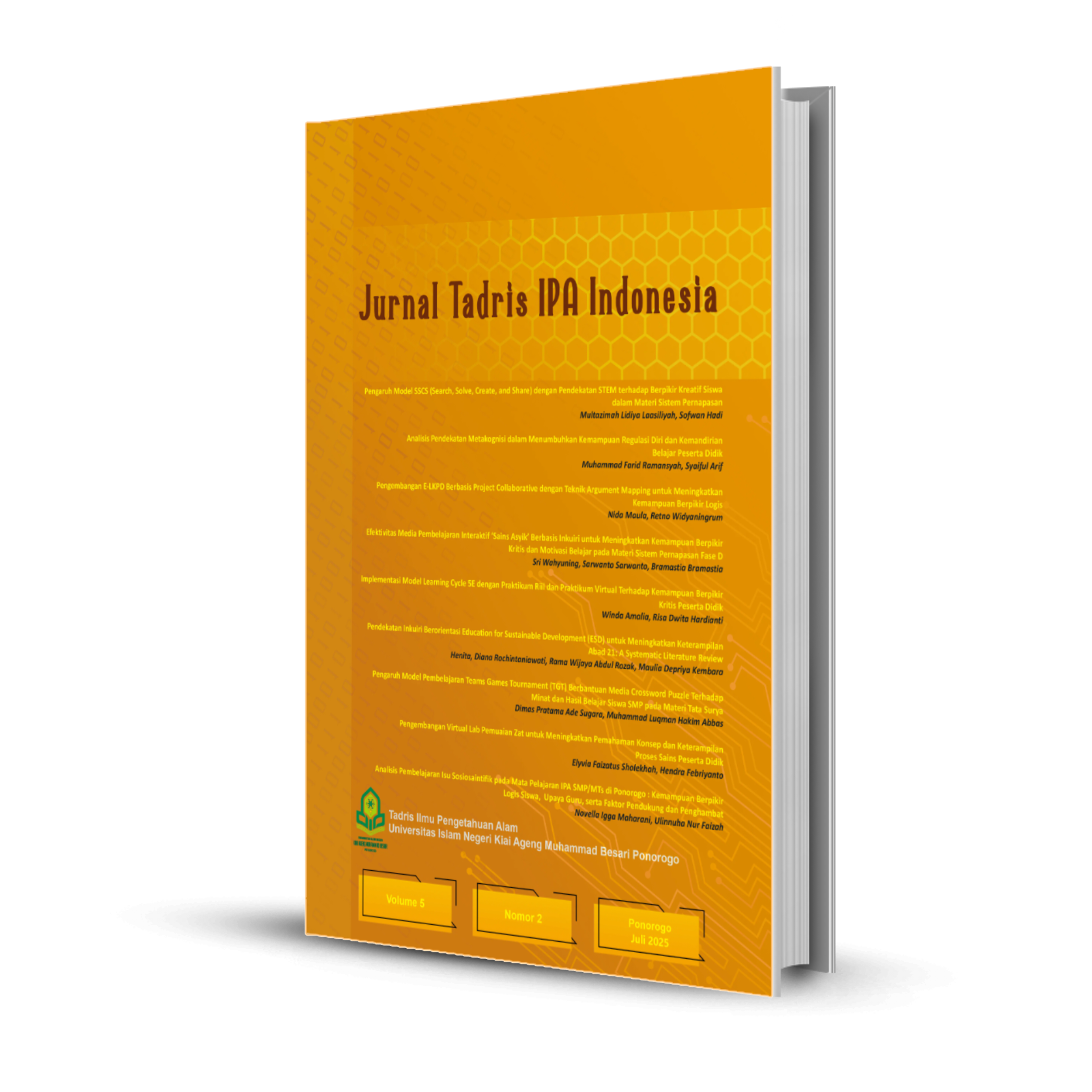
Pendekatan Inkuiri Berorientasi Education for Sustainable Development (ESD) untuk Meningkatkan Keterampilan Abad 21: A Systematic Literature Review
DOI:
https://doi.org/10.21154/jtii.v5i2.5019Keywords:
Education for Sustainable Development (ESD),, Keterampilan Abad 21, Pendekatan inkuiri, Systematic Literature ReviewAbstract
Penelitian ini meninjau secara sistematis literatur tentang implementasi pendekatan inkuiri berorientasi Education for Sustainable Development (ESD) dalam pengembangan keterampilan abad ke-21. Dengan metode Systematic Literature Review (SLR) mengacu PRISMA 2020, teridentifikasi 21 artikel terbit tahun 2020–2025 dari Scopus dan Google Scholar. Temuan menunjukkan keterampilan yang paling konsisten dikaitkan ialah 4Cs (berpikir kritis, kolaborasi, komunikasi, kreativitas). Model yang paling efektif meliputi guided inquiry, problem-based learning, dan project-based inquiry yang dipadukan dengan isu keberlanjutan. Keberhasilan implementasi terutama didukung integrasi teknologi, asesmen autentik, dan kompetensi guru, sementara tantangan utama meliputi lemahnya integrasi ESD dalam dokumen pembelajaran, kesiapan guru, kesenjangan asesmen, serta konteks lokal yang belum banyak dieksplorasi. Kebaruan kajian ini terletak pada sintesis mutakhir 2020–2025 yang memetakan pola keterkaitan 4Cs dengan inkuiri serta ESD sekaligus menegaskan faktor pendorong, hambatan, dan celah riset lintas konteks. Temuan ini penting bagi pendidikan IPA karena inkuiri merepresentasikan praktik ilmiah, dan integrasi ESD membuat pembelajaran IPA lebih relevan untuk membangun literasi sains serta kompetensi keberlanjutan dalam menghadapi persoalan lingkungan dan sosial yang kompleks.
References
Aribowo, S., Nadiroh, N., & Faesal, M. (2025). Implementation of Experiential Learning Methods in Environmental Education. International Journal of Business, Law, and Education, 6(1), 468-476.
Boeve-de Pauw, J., Olsson, D., Berglund, T., & Gericke, N. (2022). Teachers’ ESD self-efficacy and practices: A longitudinal study on the impact of teacher professional development. Environmental Education Research, 28(6), 867-885.
Chu, S. K. W., Reynolds, R. B., Tavares, N. J., Notari, M., & Lee, C. W. Y. (2021). 21st century skills development through inquiry-based learning from theory to practice. Springer International Publishing.
Diez-Ojeda, M., Queiruga-Dios, M. Á., Velasco-Pérez, N., López-Iñesta, E., & Vázquez-Dorrío, J. B. (2021). Inquiry through industrial chemistry in compulsory Secondary Education for the achievement of the development of the 21st Century skills. Education Sciences, 11(9), 475.
Eliyawati, Widodo, A., Kaniawati, I., & Fujii, H. (2023). The development and validation of an instrument for assessing science teacher competency to teach ESD. Sustainability, 15(4), 3276.
Elmassah, S., Biltagy, M., & Gamal, D. (2022). Framing the role of higher education in sustainable development: a case study analysis. International journal of sustainability in higher education, 23(2), 320-355.
Evans, N., Inwood, H., Christie, B., & Ärlemalm-Hagsér, E. (2021). Comparing education for sustainable development in initial teacher education across four countries. International Journal of Sustainability in Higher Education, 22(6), 1351-1372.
González-Pérez, L. I., & Ramírez-Montoya, M. S. (2022). Components of Education 4.0 in 21st century skills frameworks: systematic review. Sustainability, 14(3), 1493.
Grosseck, G., Țîru, L. G., & Bran, R. A. (2019). Education for sustainable development: Evolution and perspectives: A bibliometric review of research, 1992–2018. Sustainability, 11(21), 6136.
Günther, J., Overbeck, A. K., Muster, S., Tempel, B. J., Schaal, S., Schaal, S., ... & Otto, S. (2022). Outcome indicator development: Defining education for sustainable development outcomes for the individual level and connecting them to the SDGs. Global Environmental Change, 74, 102526.
Gusenbauer, M., & Haddaway, N. R. (2020). Which academic search systems are suitable for systematic reviews or meta‐analyses? Evaluating retrieval qualities of Google Scholar, PubMed, and 26 other resources. Research synthesis methods, 11(2), 181-217.
Hariyonoa, E., & Madlazimb, S. A. (2020). The effectiveness of volcanology learning through inquiry based on education for sustainable development. Journal of Science Education, 20(2), 20-23.
Hoerunnisa, M., Purnamasari, S., & Lestari, W. Y. (2024). Penerapan Model Problem Based Learning berbasis Education for Sustainable Development untuk Meningkatkan Keterampilan Berpikir Kritis Pada Materi Pemanasan Global. Unnes Physics Education Journal, 13(3), 219-236.
Hogan, D., & O’Flaherty, J. (2021). Addressing education for sustainable development in the teaching of science: The case of a biological sciences teacher education program. Sustainability, 13(21), 12028.
Kamdi, N., Rochintaniawati, D., & Prima, E. C. (2022). Efektivitas Web Based Inquiry Learning pada Materi Pencemaran Lingkungan dalam Konteks ESD (Education Sustainable Development) untuk Meningkatkan Kemampuan Berinkuiri dan Kepedulian Lingkungan Siswa SMP Kelas VII. PENDIPA Journal of Science Education, 6(3), 733-738.
Khofifatul, S., & Widyaningrum, R. (2023). Pengembangan Modul Ajar Online Berbasis Science Education for Sustainable Development (SESD) untuk Meningkatkan Kemampuan Membuat Keputusan. Jurnal Tadris IPA Indonesia, 3(3), 276-292.
Kidman, G., & Casinader, N. (2019). Developing teachers' environmental literacy through inquiry-based practices. Eurasia Journal of Mathematics, Science and Technology Education, 15(6), em1687.
Kousloglou, M., Petridou, E., Molohidis, A., & Hatzikraniotis, E. (2023). Assessing students’ awareness of 4cs skills after mobile-technology-supported inquiry-based learning. Sustainability, 15(8), 6725.
Matitaputty, J. K., Ufie, A., Ima, W., & Pattipeilohy, P. (2022). Implementasi Education for Sustainable Development (Esd) Melalui Ekopedagogi Dalam Pembelajaran Di Smp Negeri 8 Ambon. Budimas: Jurnal Pengabdian Masyarakat, 4(1), 109-116.
Meda, T. (2022). Analisis Potensi RPP Education for Sustainable Development pada Mata Pelajaran Fisika SMA. Ideguru: Jurnal Karya Ilmiah Guru, 7(3), 344-352.
Mongeon, P., & Paul-Hus, A. (2016). The journal coverage of Web of Science and Scopus: a comparative analysis. Scientometrics, 106, 213-228.
Murphy, C., Smith, G., Mallon, B., & Redman, E. (2020). Teaching about sustainability through inquiry-based science in Irish primary classrooms: the impact of a professional development programme on teacher self-efficacy, competence and pedagogy. Environmental Education Research, 26(8), 1112-1136.
Ningsih, S., Miko, N. A., Prayetno, B. E., Sari, D. P., Arnilis, Y., Tonara, A., ... & Yanti, S. (2025). Transformasi Pendidikan Untuk Mendukung Sustainable Development Goals: Mempersiapkan Generasi Muda Menghadapi Tantangan Era Society 5.0. SAMBARA: Jurnal Pengabdian Kepada Masyarakat, 3(2), 252-259.
Novitra, F. (2021). Development of Online-Based Inquiry Learning Model to Improve 21st-Century Skills of Physics Students in Senior High School. Eurasia Journal of Mathematics, Science and Technology Education, 17(9).
Odewole, P. O., Sobowale, T. O., & Uzzi, F. O. (2023). The place of design education in achieving 4IR sustainability through the 4Cs skill-sets. Design and Technology Education: An International Journal, 28(2), 89-106.
Page, M. J., McKenzie, J. E., Bossuyt, P. M., Boutron, I., Hoffmann, T. C., Mulrow, C. D., ... & Moher, D. (2021). The PRISMA 2020 statement: an updated guideline for reporting systematic reviews. bmj, 372.
Park, S. Y., & Pak, S. Y. (2025). Tracking the transformative values of a youth ESD program: a post-program examination through qualitative inquiry. Environmental Education Research, 1-18.
Prahani, B. K., Susiawati, E., Deta, U. A., Lestari, N. A., Yantidewi, M., Jauhariyah, M. N. R., ... & Siswanto, J. (2021, February). Profile of students’ physics problem-solving skills and the implementation of inquiry (free, guided, and structured) learning in senior high school. In Journal of Physics: Conference Series (Vol. 1747, No. 1, p. 012012). IOP Publishing.
Prayogi, S., Ahzan, S., Indriaturrahmi, I., & Rokhmat, J. (2022). Opportunities to stimulate the critical thinking performance of preservice science teachers through the ethno-inquiry model in an e learning platform. International Journal of Learning, Teaching and Educational Research, 21(9), 134-153.
Priandini, A. B., & Aristiawan, A. (2024). Efektivitas Model Pembelajaran Think Pair Share dengan Pendekatan Education for Sustainability Development (ESD) untuk Meningkatkan Kemampuan Kolaborasi Peserta Didik. Jurnal Tadris IPA Indonesia, 4(1), 141-156.
Puspitasari, E. (2024). SDGs-based adaptive curriculum model to improve education quality in the digital age. Inovasi Kurikulum, 22(1), 1-12.
Rieckmann, M. (2018). Learning to transform the world: Key competencies in Education for Sustainable Development. Issues and trends in education for sustainable development, 39(1), 39-59.
Riesenberg, L. A., & Justice, E. M. (2014). Conducting a successful systematic review of the literature, part 1. Nursing2024, 44(4), 13-17.
Rodliyah, U., & Fadly, W. (2023). Meningkatkan kemampuan kolaborasi melalui model guided inquiry berbasis education for sustainable development pada materi biotik dan abiotik. Jurnal Tadris IPA Indonesia, 3(2), 169-179.
Rodríguez-Zurita, D., Jaya-Montalvo, M., Moreira-Arboleda, J., Raya-Diez, E., & Carrión-Mero, P. (2025). Sustainable development through service learning and community engagement in higher education: a systematic literature review. International Journal of Sustainability in Higher Education, 26(1), 158-201.
Septyaningrum, K., & Lestari, N. A. (2023). Validitas Perangkat Pembelajaran Project-Based Inquiry Science Terintegrasi Pendidikan Lingkungan untuk Meningkatkan Kemampuan Berpikir Kritis. Jurnal Ilmu Pendidikan dan Pembelajaran, 2(1), 1-16.
Setiyaningsih, L. B., Riandi, R., Amprasto, A., & Mardiyah, M. (2024). Application of the Inquiry-Based Learning Model with Education for Sustainable Development to Enhance Critical Thinking Skills and Sustainable Awareness. Jurnal Penelitian Pendidikan IPA, 10(10), 7790-7802.
Singh, V. K., Singh, P., Karmakar, M., Leta, J., & Mayr, P. (2021). The journal coverage of Web of Science, Scopus and Dimensions: A comparative analysis. Scientometrics, 126, 5113-5142.
Tahmid, T., Nurkhoiri, N., & Syaiful, M. (2024). Implementasi Perangkat Belajar Sains Berbasis ESD pada Materi Pencemaran Lingkungan untuk Peningkatan Literasi dan Keterampilan Berpikir Kritis Siswa: Implementasi Perangkat Belajar Sains Berbasis ESD pada Materi Pencemaran Lingkungan untuk Peningkatan Literasi dan Keterampilan Berpikir Kritis Siswa. Diklabio: Jurnal Pendidikan dan Pembelajaran Biologi, 8(2), 235-245.
Ülger, B. B., & Çepni, S. (2020). Evaluating the effect of differentiated inquiry-based science lesson modules on gifted students' scientific process skills. Pegem Journal of Education and Instruction, 10(4), 1289-1324.
UNESCO. (2018). Issues and trends in Education for Sustainable Development Issues and trends in Education. Paris, France: UNESCO Publishing.
Urdanivia Alarcon, D. A., Talavera-Mendoza, F., Rucano Paucar, F. H., Cayani Caceres, K. S., & Machaca Viza, R. (2023, May). Science and inquiry-based teaching and learning: a systematic review. In Frontiers in Education (Vol. 8, p. 1170487). Frontiers Media SA.
Weatherhead, N. K. (2020). Integrated Techniques to Increase Systems Thinking for Sustainability Education of High School Science Students Using Educational Design Research (Doctoral dissertation, University of South Carolina).
Yidana, M. B., & Aboagye, G. K. (2024). Towards developing a 21st century curriculum through the perspective of the community of inquiry (CoI) framework. Cogent Social Sciences, 10(1), 2364387.
Downloads
Published
Issue
Section
License
Jurnal Tadris IPA Indonesia allow the author(s) to hold the copyright without restrictions and allow the author(s) to retain publishing rights without restrictions, also the owner of the commercial rights to the article is the author.