
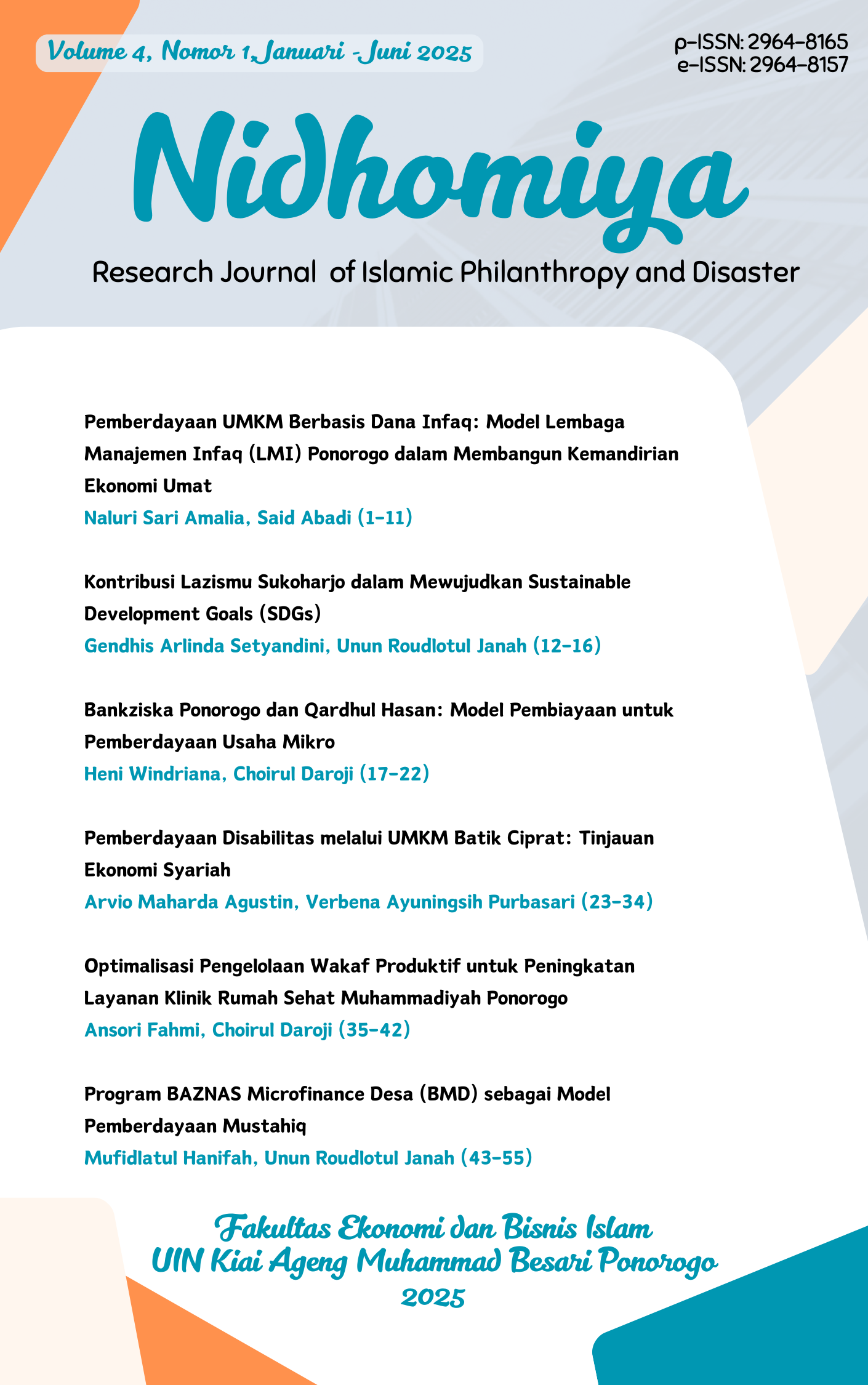
Pemberdayaan Disabilitas melalui UMKM Batik Ciprat: Tinjauan Ekonomi Syariah
DOI:
https://doi.org/10.21154/nidhomiya.v4i1.4976Abstract
This research is motivated by the importance of the role of “Batik Ciprat” MSMEs in improving the welfare of people with disabilities, who have often been underestimated due to their limitations. The Batik Ciprat program, initiated by the Ministry of Social Affairs, aims to provide economic independence for individuals with disabilities. The objectives of this study are to analyze: 1) the level of community welfare, 2) the supporting and inhibiting factors of MSMEs, and 3) the role of MSMEs in enhancing welfare. The research uses a qualitative method with a field study approach, collecting data through interviews, observations, and documentation. Data analysis follows the Miles & Huberman model, and data validity is ensured through the triangulation technique. The research findings indicate that welfare is assessed through economic, educational, health, and social protection aspects. Supporting factors for MSMEs include capital assistance, natural resources, appropriate technology, outreach, marketing strategies, and strategic locations. Inhibiting factors involve low technology production and limited market access. UMKM plays a vital role in reducing unemployment and poverty, improving welfare, and strengthening national character, especially for people with disabilities.
References
Aliyah, A. H. (2022). Peran Usaha Mikro Kecil dan Menengah (UMKM) untuk Meningkatkan Kesejahteraan Masyarakat. WELFARE Jurnal Ilmu Ekonomi, 3(1), 64–72. https://doi.org/10.37058/wlfr.v3i1.4719
Aripah, I. (2023). Hasil Pemberdayaan Penyandang Disabilitas Binaan Yayasan Wisna Vhesire Cilandak Jakarta Selatan UIN Syarif Hidayatullah Jakarta, Jakarta, Indonesia).
Bungin, B. (2000). Metode Penelitian Kualitatif. PT. Raja Grafindo Persada, Jakarta.
Candra, E. M. (2022). Peran UMKM dalam Meningkatkan Kesejahteraan Masyarakat Menurut Perspektif Ekonomi Islam ( Studi Kasus Umkm Pekanbaru ). Ar- Ribhu, 5(2), 385–391.
Fauziah, S. (2024). Dasar-Dasar Kewirausahaan: Teori dan Panduan Berwirausaha. PT. Sonpedia Publising Indonesia, Jambi.
Febriani, S., & Harmain, H. (2022). Analisis Faktor Penghambat dan Pendukung Perkembangan UMKM Serta Peran Dewan Pengurus Wilayah Asprindo Dalam Perkembangan UMKM Di Sumatera Utara Pada Masa Pandemi Covid-19. Al-Kharaj : Jurnal Ekonomi, Keuangan & Bisnis Syariah, 5(3), 1275–1290. https://doi.org/10.47467/alkharaj.v5i3.1624
Hamdani. (2020). Mengenal Usaha Mikro dan Mengenal (UMKM) Lebih Dekat. Uwais Inspirasi Indonesia, Ponorogo.
Mulyati, T., Rohmatiah, A., & Amadi, D. N. (2019). Pelatihan Dan Pendampingan Penyandang Disabilitas Desa Simbatan, Kecamatan Nguntoronadi Kabupaten Magetan. Jurnal Terapan Abdimas, 4(2), 187. https://doi.org/10.25273/jta.v4i2.4844
Sakur. (2021). Kajian Faktor-Faktor yang Mendukung Pengembangan Usaha Mikro Kecil dan Menengah: Studi Kasus di Kota Surakarta. Spirit Publik, 7(2), 85-110.
Sanusi. (2015). Faktor Penentu Keberhasilan UMKM Pada Klaster Bordir dan Konveksi Kudus. Iqtishadia, 41-58.
Sugiyono. (2016). Metode Penelitian. Alfabeta, Bandung.
Sawitri, A. P., Asjari, F., Adi, B., & Utomo, S. P. (2021). Penguatan UMKM Penyandang Disabilitas Naeema Melalui Perijinan Usaha dan Modal Usaha. Ekobis Abdimas : Jurnal Pengabdian Masyarakat, 2(2), 80–87. https://doi.org/10.36456/ekobisabdimas.2.2.4856
Yolanda, C. (2024). Peran Usaha Mikro, Kecil Dan Menengah (Umkm) Dalam Pengembangan Ekonomi Indonesia. Manajemen Bisnis, 2(3), 170–186.
Yindrizal. (2023). Pengantar Akuntansi Untuk UMKM. Azka Pustaka, Pasaman Barat.
Downloads
Published
Issue
Section
License
Nidhomiya allows the author(s) to hold the copyright without restrictions and allows the author(s) to retain publishing rights without restrictions; also, the owner of the commercial rights to the article.