
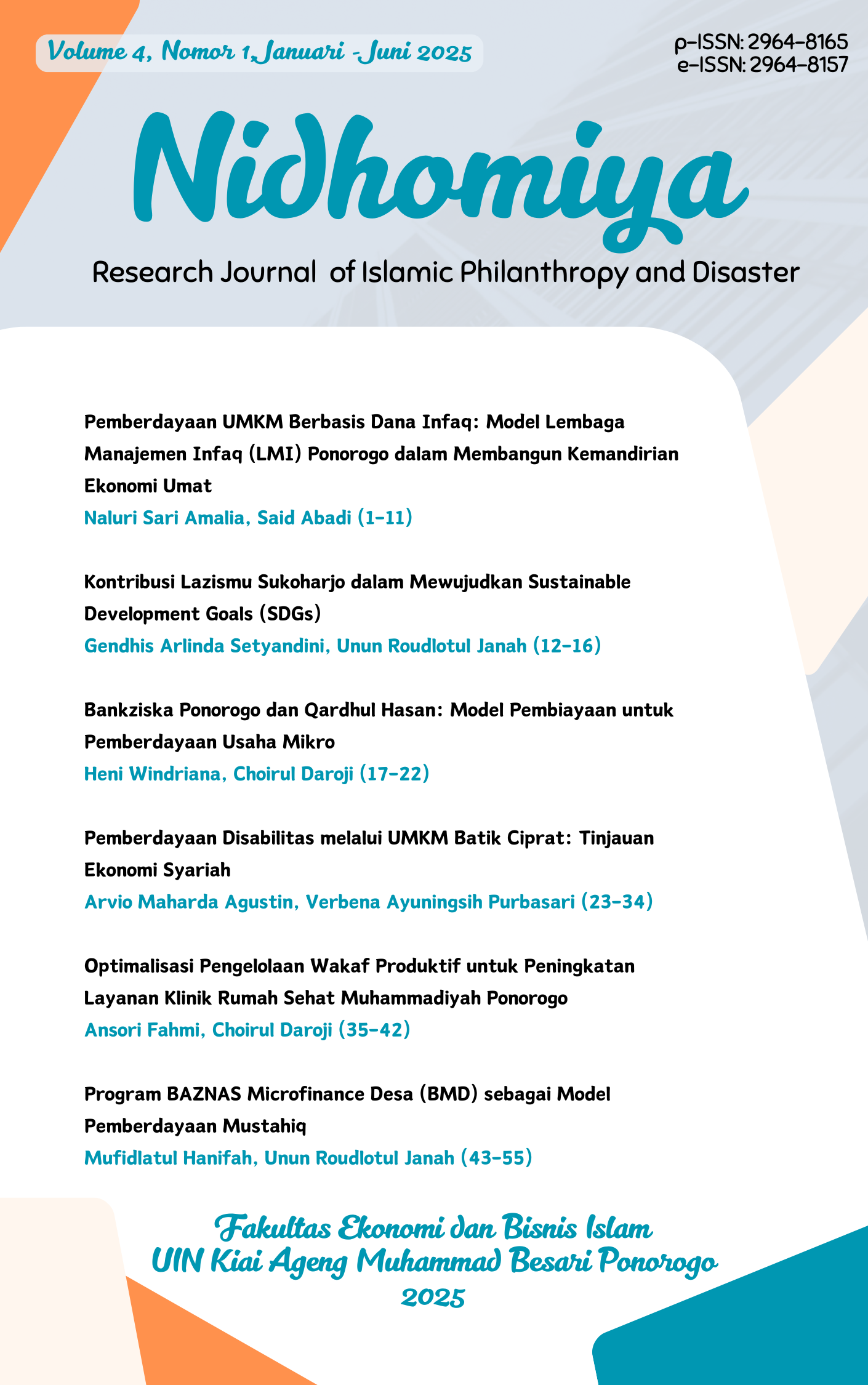
Program BAZNAS Microfinance Desa (BMD) sebagai Model Pemberdayaan Mustahiq
DOI:
https://doi.org/10.21154/nidhomiya.v4i1.5008Abstract
The purpose of this study is to analyze the empowerment of mustahiq (zakat beneficiaries) through the Baznas Microfinance Desa (BMD) program in Ponorogo Regency and to assess its impact on their economic and social well‑being. The BMD program, initiated by BAZNAS RI, is a financial intermediation initiative that provides zakat‑based loans using the qardhul hasan contract. Its primary goal is to support micro‑entrepreneurs from the mustahiq group by addressing their capital constraints and reducing dependence on exploitative moneylenders. This qualitative study explores the implementation of the BMD program in Ponorogo Regency, focusing on institutionalization, group formation, and the joint liability system. Data were collected through interviews, observations, and documentation to gain an in‑depth understanding of the program’s effectiveness and its impact on the economic and social status of mustahiq. The study also identifies supporting and inhibiting factors and analyzes how BAZNAS Ponorogo manages and integrates the BMD initiative. The results show that the BMD program has had a generally positive impact, increasing mustahiq’s business capital and income. However, its effectiveness is still limited due to a lack of regular supervision and intensive monitoring of mustahiq business development. Not all mustahiq have been able to sustain their businesses independently. To optimize its impact, the program needs enhanced capacity‑building measures and more intensive mentoring. These improvements will help the BMD program achieve its goal of promoting sustainable economic empowerment and further reduce the reliance of low‑income communities on moneylenders.
References
Al-Arif, M.Nur Rianto. 2012. Lembaga Keuangan Syariah. Bandung : Pustaka Setia.
Ariyanti. 2025. Wawancara Langsung.
Asmita, Budi, Dyah R. Andayani, R. Melda Maesarach. 2021. Penilaian Dampak Investasi Sosial Program BAZNAS Microfinance Desa Menggunakan Metode Social Return on Investment (SROI). Jakarta : Prosiding Konferensi Nasional Ekonomi Manajemen dan Akuntansi.
Endah. 2025. Wawancara Langsung.
Febriansyah, Sigit, Ikhwan Hamdani, Gunawan Ikhtiono, 2021. Efektivitas Program BAZNAS Microfinance di Desa Bojong Rangkas Ciampea Bogor. Bogor : El-Mal: Jurnal Kajian Ekonomi & Bisnis Islam.
Katini. 2025. Wawancara Langsung.
Masruroh. 2025. Wawancara Langsung.
Nurwanda, Asep. 2020. Analisis Program Inovasi Dalam Mendorong Pengembangan Ekonomi Lokal Oleh TIM Pelaksana Inovasidesa (PID) di Desa Bangunharja Kabupaten Ciamis. Dinamika: Jurnal Ilmiah Ilmu Administrasi Negara.
Sari, Meita Sekar dan Muhammad Zefri. 2019. Pengaruh Akuntabilitas, Pengetahuan, Dan Pengalaman Pegawai Negeri Sipil Beserta Masyarakat Terhadap Kualitas Pengelola Dana Kelurahan di Lingkungan Kecamatan Langkapura.
Sugiyono. 2012. Metodologi Penelitian Pendidikan Pendekatan Kuantitatif, Kualitatif dan R&D. Bandung: Alfabeta
Tiara. 2025. Wawancara Langsung.
Umar Sidiq dkk. 2009. Metode Penelitian Kualitatif Di Bidang Pendidikan, Journal of Chemical Information and Modeling, Vol. 53, 2019, 39 Http://Repository.Iainponorogo.Ac.Id/484/1/METODE
Wahyuningsih, Tri. Konsep Pengelolaan Zakat Produktif Berdasarkan Indeks Desa Zakat di Desa Cupak, Kabupaten Jombang.
Downloads
Published
Issue
Section
License
Nidhomiya allows the author(s) to hold the copyright without restrictions and allows the author(s) to retain publishing rights without restrictions; also, the owner of the commercial rights to the article.